Solar-Powered EV Cold Storage in India: How Zero-Diesel Cold Chains Are Saving Farm Produce (and Money)
Discover how India’s first solar-powered EV cold storage cuts diesel costs to zero, reduces post-harvest losses, and delivers reliable cold-chain from farm to market. A complete 2026 guide.
Every year, India grows enough fruits, vegetables, dairy, and pharmaceuticals to feed and heal a large part of the world. And every year, a heartbreaking share of that produce never reaches a plate or a pharmacy shelf. It rots on the way — in the gap between the farm and the market, in the hours when there was no cooling, no power, and no affordable way to keep things cold.
That gap has a name: the broken cold chain. And for the first time, it’s being closed not with more diesel generators or more grid connections, but with the sun.
This blog breaks down how solar-powered EV cold storage works, why it matters right now, and what businesses — from farms to pharma — should understand before they invest in one.
What Is Solar-Powered EV Cold Storage?
Let’s define it clearly, because the term gets thrown around loosely.
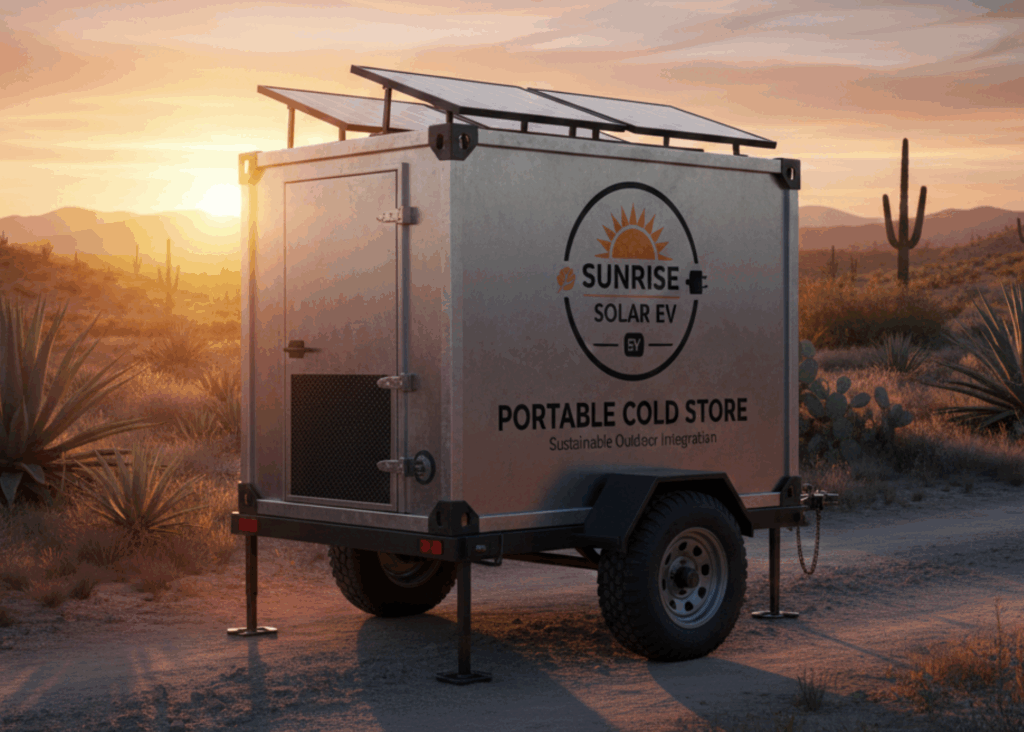
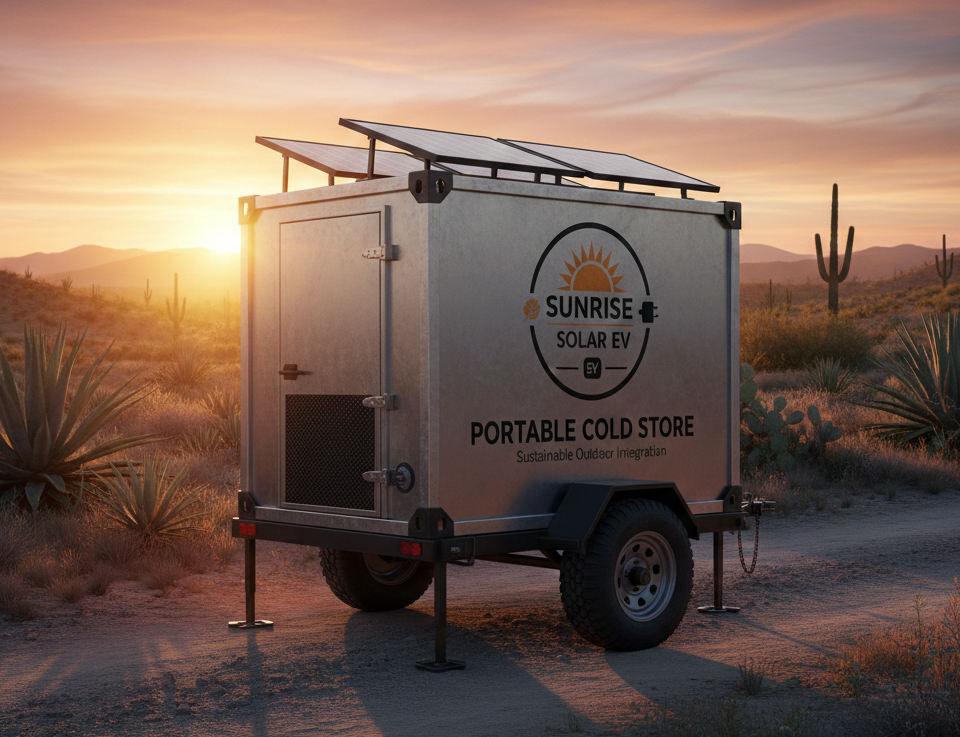
Solar-powered EV cold storage is a refrigeration system — a cold room or a reefer (refrigerated) van — that runs entirely on solar energy with battery backup, requiring zero diesel and zero grid electricity to keep produce cold.
Break it into its parts:
- Solar-powered — Solar panels generate the electricity that runs the refrigeration unit.
- EV-integrated — The system uses electric-vehicle-grade battery and drive technology, so the cooling continues even when the sun isn’t shining and, in the case of reefer vans, while the vehicle is on the move.
- Cold storage — The end result: a temperature-controlled space (a fixed cold room or a mobile van) that preserves perishable goods.
In plain terms: it’s a cold room or a cold truck that pays no fuel bill and no electricity bill, and keeps working in places where the power grid doesn’t reach.
Why India Needs This Right Now
India is the second-largest producer of fruits and vegetables in the world. But a significant portion of that harvest is lost after picking — largely because of inadequate cold-chain infrastructure. When a farmer harvests tomatoes at dawn and there’s no cooling available until they reach a distant mandi hours later, the clock is already working against them.
The traditional solutions all have a catch:
- Diesel-powered cold rooms and reefers work, but they burn expensive fuel, emit carbon, and their running cost climbs with every rupee added to the diesel price.
- Grid-connected cold storage depends on reliable electricity — which large parts of rural and semi-rural India simply do not have. Power cuts mean spoiled stock.
- No cold chain at all — the default for millions of small farmers — means selling in a rush at whatever price the market offers, or watching produce spoil.
Solar EV cold storage removes the two biggest weaknesses at once: the fuel bill and the grid dependency. Once the equipment is installed, sunlight is free and it falls everywhere — including on the remote farms and rural collection points where the grid never arrived.
How Does It Actually Work? (Step by Step)
For anyone evaluating this technology, here’s the mechanism in simple terms:
- Solar panels mounted on the cold room roof, the reefer van, or a nearby structure capture sunlight and convert it into electricity.
- That electricity powers the refrigeration compressor that cools the insulated chamber.
- Excess energy generated during peak daylight is stored in a battery bank (EV-grade).
- When sunlight drops — cloudy weather, night, or early morning — the battery backup takes over, keeping the temperature stable around the clock.
- Because the whole system is portable and self-contained, it can be placed at a farm, a market yard, a warehouse, or driven directly on a route.
The result is continuous, reliable cooling with no diesel refills and no meter reading — a cold chain that runs on its own power.
Who Benefits Most From Solar Cold Storage?
This is not a one-size-fits-all product. The strongest use cases are businesses where cooling is mission-critical and downtime is expensive:
Farms and Farmer Producer Organizations (FPOs)
Store produce at the farm gate immediately after harvest, extend shelf life, and sell when prices are favourable instead of dumping at harvest-time lows.
Retail and Food Chains
Keep fruits, vegetables, dairy, and frozen goods fresh across distribution, with predictable cooling costs and no dependence on unreliable rural power.
Pharmaceutical and Healthcare Supply
Vaccines, biologics, and many medicines require unbroken temperature control. A solar system with battery backup provides the reliability this sector demands, even in areas with weak infrastructure.
Food Processing and FMCG
Maintain temperature compliance across storage and transport, protecting both product quality and regulatory standing.
Fisheries, Dairy, and Meat
Perishables that spoil fastest gain the most from cooling that starts at the source and travels with the goods.
The Business Case: Where the Real Savings Come From
Sustainability is the headline, but for most business owners the decision comes down to numbers. Here’s where solar EV cold storage delivers value:
Zero fuel cost. A diesel reefer’s running cost is tied to a price you don’t control. Solar’s “fuel” is sunlight — free and inflation-proof.
Zero grid bills and zero grid risk. No electricity charges, and no losses from unexpected power cuts.
Lower post-harvest loss. Every kilogram of produce that reaches market instead of the compost heap is direct recovered revenue. For a farm or trader, reducing spoilage even modestly can transform margins.
Longer shelf life = pricing power. Cold storage lets sellers hold stock and sell into stronger markets rather than distress-selling at harvest peaks.
Reduced emissions and a genuine green credential. Increasingly, buyers, exporters, and institutional partners want low-carbon supply chains. A zero-diesel cold chain is a real, provable sustainability claim — not greenwashing.
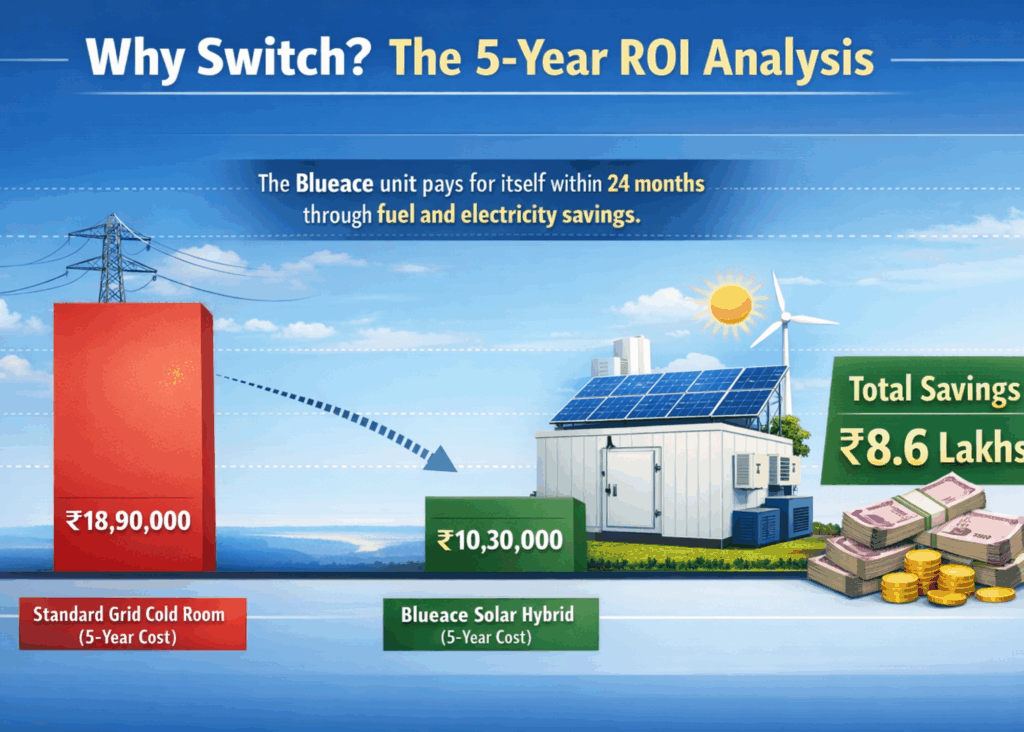
Over the life of the equipment, the elimination of fuel and electricity bills is what makes solar cold storage compelling. The upfront investment is offset by years of near-zero running cost.
Fixed Cold Rooms vs Solar Reefer Vans: Which One?
Two main formats exist, and the right choice depends on where the cooling problem lives.
Portable solar cold rooms are best when produce needs to be stored at one location — a farm, a collection centre, a market yard, a warehouse. They create a stationary cold buffer that holds stock until it’s ready to move.
Solar reefer vans are best when the challenge is transport — moving perishables across distance while keeping them cold every kilometre of the way. They’re a mobile cold chain on wheels.
Many operations need both: a cold room to store at the source and a reefer van to carry to market. The strength of a modular, portable approach is that you can match the exact combination to your route, capacity, and produce type — rather than forcing your business into a fixed template.
What to Look For When Choosing a Solar Cold Storage Provider
If you’re evaluating vendors, these are the factors that separate a reliable partner from a risky one:
- True 100% solar with battery backup — Confirm the system genuinely runs without grid or diesel dependency, and that the battery capacity is sized for your climate and usage, including cloudy days and night operation.
- Customization — Your cold room or van should be built around your capacity, route, and produce type, not sold as a generic box.
- Engineering depth — Cold-chain performance in India’s heat is unforgiving. Look for a provider with genuine solar and refrigeration engineering experience.
- Portability and self-containment — The value of solar is reaching places the grid can’t. Make sure the unit can actually be deployed where you need it.
- Support and uptime commitment — Cold-chain downtime spoils stock. Dependable service matters as much as the hardware.
- Made-in-India manufacturing — In-house manufacturing typically means better customization, faster support, and easier spares.
Frequently Asked Questions
Does solar cold storage work at night and on cloudy days?
Yes. Solar panels charge a battery bank during daylight, and the battery backup runs the cooling when sunlight is low — through the night and on overcast days — keeping temperature stable around the clock.
Is it really zero diesel and zero grid?
A properly designed system runs entirely on solar plus battery, with no diesel generator and no grid connection required. This is the core advantage: no fuel bills and no electricity bills.
Can it be used in remote areas with no electricity?
This is exactly where solar cold storage shines. Because it makes its own power from sunlight, it delivers reliable cooling in locations the grid never reached.
What can I store in it?
Fruits, vegetables, dairy, fish, meat, flowers, processed foods, and temperature-sensitive pharmaceuticals — essentially any perishable that needs controlled cold conditions.
Is it suitable for small farmers or only large businesses?
Portable, modular units can be scaled to different capacities, making them relevant for individual farms and FPOs as well as retail chains, pharma, and large food processors.
How does it reduce post-harvest losses?
By providing cooling right at the source — immediately after harvest — and maintaining it through storage and transport, it slows spoilage and extends the window to reach market in good condition.
The Bigger Picture: A Cold Chain That Runs on Sunlight
Step back and the significance is clear. For decades, cold storage in India has been chained to two things it couldn’t always rely on: a fuel supply that keeps getting costlier, and a power grid that doesn’t reach everyone. Solar-powered EV cold storage cuts both chains.
It means a farmer in a village without reliable electricity can preserve a harvest. It means a pharma distributor can maintain the cold chain in a region the grid forgot. It means a food business can plan its cooling costs at effectively zero for years, while cutting emissions at the same time.
This is what makes solar EV cold storage more than a product — it’s infrastructure for a country that grows enormous amounts of food and loses far too much of it. Zero diesel, zero grid, zero compromise on freshness. Cooling that goes wherever the produce goes, powered by the one resource India has in abundance: sunlight.
For farms, retailers, pharma, and food industries ready to fix their cold chain from the ground up, the technology is here, it’s proven, and it’s Indian-made.