Solar Cold Storage is no longer a “future idea” or a government brochure concept—it’s already changing how Indian farmers, traders, and rural businesses survive and grow. Let’s be honest: post-harvest losses in India are brutal. Fruits, vegetables, dairy, flowers—nearly 25–30% produce is wasted before it even reaches the market. That’s not a farming problem; that’s a storage and energy problem.
And guess what? Solar is finally stepping up where diesel and unreliable grids have failed.
The Real Problem: Good Produce, Bad Storage
Indian farmers know how to grow. They’ve been doing it for generations. What they don’t control is:
-
Power cuts during peak harvest
-
Rising diesel prices
-
Expensive cold storage rentals
-
Long transport times without temperature control
Traditional cold storage depends heavily on grid electricity or diesel gensets. Both are costly, unpredictable, and honestly outdated for rural India. When power goes, so does the produce—and so does the farmer’s profit.
This is exactly where Solar Cold Storage flips the script.
Off-Grid Profits: Why Rural Businesses Are Switching to Solar
Let’s talk money, not theory.
Solar-powered cold storage systems work independently of the grid, using solar panels with battery backup or hybrid systems (solar + grid/DG). For rural businesses—FPOs, mandis, traders, dairy operators—this means:
-
Zero or near-zero electricity bills
-
No dependency on diesel
-
Stable temperature 24×7
-
Predictable operating costs
Instead of paying monthly power bills, you invest once and save every month. Old-school wisdom says, “Jo cheez apni ho, wahi sasti padti hai.” Solar proves that true.
Traditional vs. Solar Cold Storage: Let’s Be Brutally Honest
Traditional Cold Storage
-
High electricity bills
-
Frequent breakdowns due to voltage fluctuation
-
Diesel backup = high running cost
-
Not viable in remote areas
Solar Cold Storage
-
Uses free sunlight (India has plenty, no shortage here 🌞)
-
Lower operational cost
-
Works even in off-grid villages
-
Scalable—from small farmer units to large supply chains
In the middle of any serious comparison, Solar Cold Storage clearly wins on long-term economics and reliability.
Case Study: How Solar Cold Storage Saves Small Farmers Real Money
Let’s break it down with a realistic example.
A small vegetable farmer collective installs a 10–15 MT solar cold storage near the farm gate.
Monthly savings:
-
Diesel cost avoided: ₹18,000–₹25,000
-
Power bill reduced: ₹8,000–₹12,000
-
Reduced wastage (20% → 5%): extra ₹20,000+ saved
Total benefit:
👉 ₹40,000–₹60,000 per month saved or earned
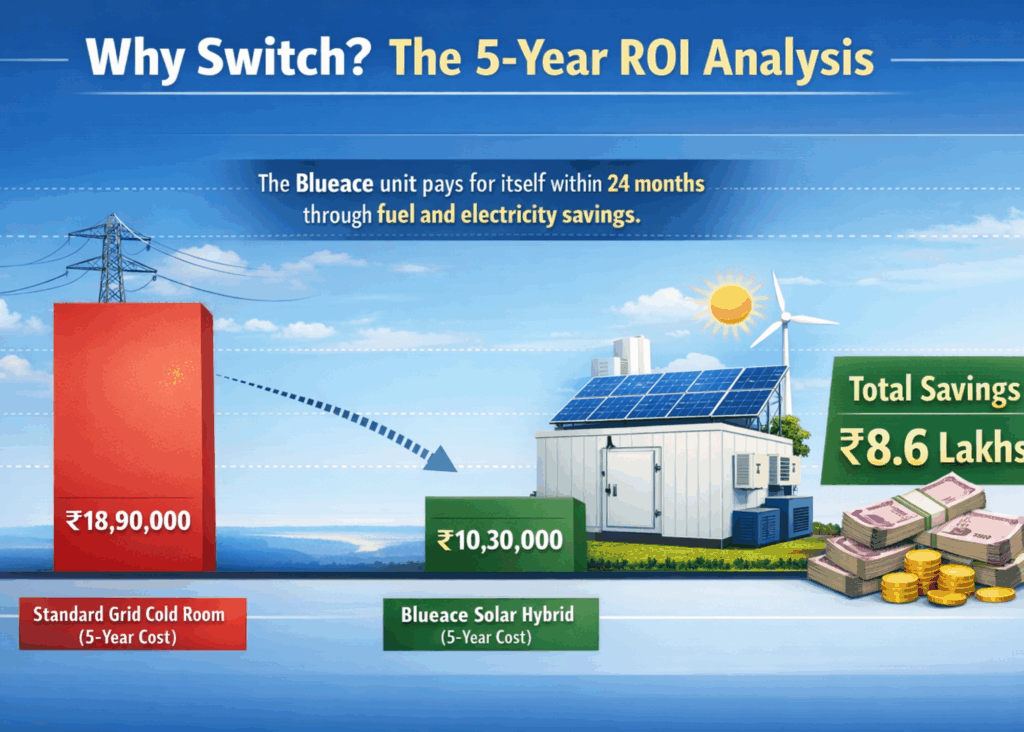
That’s not a “scheme number.” That’s real cash flow improvement. Over a year, that’s ₹5–7 lakh impact—enough to change how a farm business operates.
Why This Matters for the Entire Supply Chain
This isn’t just about farmers. Solar cold storage helps:
-
Agri exporters maintain quality
-
Cold chain startups reduce OPEX
-
Retailers get consistent supply
-
Rural youth run storage as a business
It strengthens the entire agri ecosystem—from farm to fork.
The Smart Move Forward
Let’s keep it real: solar won’t replace everything overnight. Traditional systems still have their place in cities. But for rural India, semi-urban belts, and agricultural clusters, Solar Cold Storage is not optional anymore—it’s logical.
Farmers don’t need charity. They need systems that respect their hard work and protect their produce. Solar does exactly that.
Final Word
If you’re serious about reducing post-harvest loss, increasing farmer income, and building a sustainable agri supply chain, Solar Cold Storage is the answer—practical, proven, and profitable.
Old problems need new power. And in this case, that power literally comes from the sun.
Solar Cold Storage isn’t the future. It’s already here. 🌱⚡